Ruby Programming Language in Switzerland



Why we recommend Ruby

Ruby is a modern programming language from Japan. It is easy to learn and stands out from other languages through better readability, shorter code and fewer special characters. With frameworks like Ruby on Rails, web applications can be built much faster. Ruby on Rails powers companies like Shopify, whose merchants sold a combined 14.6 billion dollars over the Black Friday / Cyber Monday weekend 2025.
Ruby was created in 1995 by Yukihiro “Matz” Matsumoto in Japan and has been developed since then as open source by an international team of volunteers and employees of Ruby companies. Ruby on Rails was created in 2004 by the Dane David Heinemeier Hansson and is developed by its own core team. It is the most popular web framework for Ruby, next to others such as Hanami, Sinatra and Roda. Ruby is also used for desktop applications with libraries like GTK3 and LibUI, and for microcontrollers with mruby and PicoRuby.
Ruby is more than Ruby on Rails
Many people only know Ruby as the language behind Rails. But Ruby is a general-purpose language that shines wherever readable code and quick results matter:
- Automation and scripts: processing files, syncing data between systems, generating reports. Ruby installs quickly on Linux and macOS and runs on Windows too.
- Command-line tools and DevOps: Homebrew, the package manager for macOS, is written in Ruby, as are Fastlane for app releases, Vagrant and Kamal.
- Websites and web services without Rails: lightweight frameworks like Sinatra, Roda and Hanami, and static site generators like Jekyll, which powers GitHub Pages. This website runs on Roda too.
- Desktop programs: graphical interfaces with Glimmer and LibUI or GTK, shipped as a single Windows .exe with OCRAN.
- In the browser: with ruby.wasm, Ruby runs right in the browser, no server needed. Our course Chunky Bacon shows how.
- Microcontrollers and devices: mruby and PicoRuby run on small chips like the Raspberry Pi Pico, and with JRuby you can write Android apps in Ruby.
- Games: DragonRuby is used to build games for PC, consoles and phones.
- Security: Metasploit, one of the best-known penetration testing tools, is written in Ruby.
- AI applications: with RubyLLM you can add language models to any Ruby program, not just Rails apps.
- Use any C library: with the Ruby-FFI gem you call functions from any C library directly from Ruby, without compiling your own C code. An AI assistant can now write the bindings from the library’s header file in a few minutes.
Ruby in brief, for CTOs and decision-makers
- Mature: Ruby is over 30 years old, Rails over 20. A new Ruby version comes out every Christmas, and old projects can be upgraded step by step. At Helvetic Ruby 2026, a speaker shows how a 3-million-line monolith was carried from Rails 3.0 to the current version over 15 years.
- Small teams, fast results: Rails comes with database access, background jobs, caching, email and frontend (Hotwire) in one package. A small team can build and run a complete web application.
- Proven at scale: Shopify, GitHub and GitLab run on Rails.
- In demand and well paid: Swiss companies keep hiring Rails developers, and job ads typically mention CHF 110,000 to 130,000 and more.
- Local community: Swiss companies such as QoQa, Renuo, Puzzle ITC and pia sponsor the Swiss Ruby conference. There are partners and experts in the country.


See Rails in action
The video series Rails 8 Unpacked by Typecraft on the official Rails channel shows how quickly a Rails application comes together: a task manager is built step by step. In the video below, Typecraft deploys the finished app to its own server with Kamal.

The video only loads from YouTube when you click it.
All episodes, most of them 12 to 20 minutes long (playlist):
- Introduction
- Login with the authentication generator
- Assets with Propshaft
- The “Solid Trifecta” overview
- Real-time messaging with Solid Cable
- Caching with Solid Cache
- Background jobs with Solid Queue
- The default Dockerfile
- Deploying with Kamal 2.0
Why Ruby and not just C#?
C# and Java are widespread in Swiss companies. Microsoft and Oracle stand behind them with large marketing budgets. Ruby has no marketing department: it is carried by its community and by the companies that succeed with it. So hearing little about Ruby in Swiss companies says little about its quality. For new web applications, internal tools and products there is a lot to be said for Ruby on Rails, and it fits into existing environments: Rails runs on Azure, Google Cloud (GCP) and AWS, works with SQL Server, login works with Entra ID, and Ruby also runs on Windows.
- Less code, fewer people: Rails has a convention for almost everything: where models, controllers, tests and migrations live and what they are called. A team of two to five people can build and run a product that would otherwise need several specialists.
- Everything in one package: login, background jobs, caching, WebSockets, email and deployment are built in since Rails 8, with no extra licences and no cloud services.
-
Your own servers, data in Switzerland: with Kamal, a Rails app deploys to any Linux server, including a Swiss hosting provider. If you would rather not manage servers, there are platforms in Switzerland that run Rails apps for you: Deploio, Gleis by towards, or Jelastic Cloud at Infomaniak. That helps with data protection (nDSG) and keeps running costs low. Ruby runs just as well in the cloud: in containers on Kubernetes or serverless on Google Cloud Run.

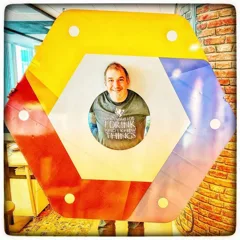 Riccardo Carlesso, Developer Advocate at Google Cloud in Zurich, shows step by step in the video Ruby on Rails with Cloud SQL on Cloud Run how a Rails app with a database runs on Cloud Run. More in his blog post.
- No vendor lock-in: Ruby and Rails are open source, carried by a community and the Rails Foundation, not by a single corporation.
- Proven over decades: Shopify, GitHub and GitLab show that Rails works at very large scale. Old Rails projects can be upgraded across many versions instead of rewritten.
- Experts nearby: the Ruby community is smaller, but experienced and well connected, and Swiss companies such as Renuo, Puzzle ITC and Base Secrète take on Rails projects.
A low-risk way to start: build your next internal tool or prototype in Rails, next to your existing software. Within a few weeks you will see how fast a small team moves with it.
Ruby in the age of AI
AI assistants like Claude Code and Copilot now write a large share of code. Ruby is a particularly good fit:
- Compact code saves tokens and money: in an analysis by Martin Alderson based on RosettaCode, Ruby is among the most token-efficient mainstream languages (summary). Ruby core developer Yusuke Endoh had Claude Code build a simplified Git in 13 languages, 20 times each (see chart below): Ruby was the fastest, cheapest and most consistent.
- Conventions help the AI: because every Rails app is structured the same way, an AI agent knows where things belong. The Rails project describes this at rubyonrails.org/ai and measures how well agents work with Rails in its own benchmark.
- Readable code is easier to review: AI-generated code still has to be read by people. Ruby reads almost like English, so reviews go faster.
- Add AI features to your own app: with RubyLLM you talk to OpenAI, Anthropic, Gemini and others through one interface, including streaming and tool calls.
- Machine learning in Ruby: there are many ML libraries for Ruby itself, for example Torch.rb for neural networks, ONNX Runtime and Informers for ready-made models, Rumale for classic machine learning, Polars for data analysis and Neighbor for vector search with pgvector. If a library is missing, the PyCall gem lets you use the Python library directly from Ruby, such as NumPy, pandas or scikit-learn.
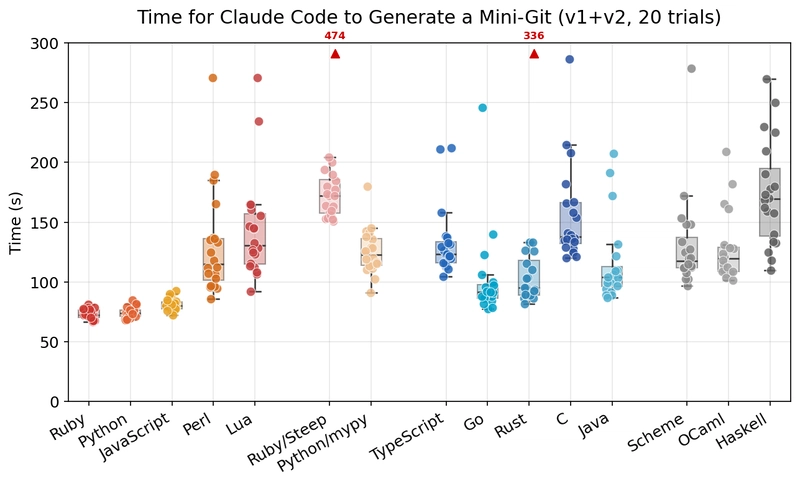
Statically typed languages took 1.4 to 2.6 times longer and cost correspondingly more. Ruby also needed almost the least code at 219 lines, compared with 303 for Java and 517 for C. C# was not part of the test; Java is the closest comparison. Code and data are public and can be checked.
Why Ruby fits AI-native companies
A program does not only live in its code, it also lives in the heads of the people who build and run it. Computer scientist Peter Naur described this back in 1985 in “Programming as Theory Building”: the real program is the team’s understanding of why the software is the way it is. Once that understanding is lost, every change becomes risky, no matter how good the code once was.
When AI writes a large share of the code, this matters more, not less. Someone has to read, understand, review and take responsibility for the generated code. The easier the code is to read, the better the team keeps its understanding. That is exactly what Ruby was made for: Matz designed Ruby for people, not for machines. Ruby code is short, reads almost like an English sentence and leaves little noise between intent and implementation.
Software development is still about people: the ones who need a solution, and the ones who understand it and keep it moving. AI makes writing faster; understanding remains our job. Ruby makes that job easier.
Talks on RubyEvents.org:
- The Rise of the Agent: Rails in the AI Era (Kinsey Durham Grace, Rails World 2025)
- Getting the Most out of AI Coding Agents for Your Rails App
- Workshop: Building AI Apps in Ruby and Rails with RubyLLM (Carmine Paolino)
- All Ruby talks about LLMs
Try Ruby without installing anything
Chunky Bacon is our free, interactive Ruby course in English and German. It runs entirely in the browser with ruby.wasm: you write and run real Ruby code right on the page. More about Chunky Bacon
Learn and look things up
- ruby-lang.org: the official Ruby website, redesigned. For Ruby’s 30th anniversary the site got a new design by Taeko Akatsuka in December 2025. The examples on the home page run right in the browser. You’ll find downloads, installation guides and news there.
- docs.ruby-lang.org: the official documentation, also with a new look.
- ruby.help: documentation with a playground. All classes and methods from Ruby 3.0 to 4.1, with keyboard search. Every example runs in the browser with one click, nothing to install (WebAssembly).
- rubyapi.org: fast search through the Ruby documentation, for every version from 2.3 to 4.0, with dark mode. Handy when you just want to check what a method does.
Who uses Ruby in Switzerland?
- Puzzle ITC with Hitobito
- Swisscom
- On Running
- Parashift: document AI, built with Ruby on Rails
- GARAIO REM: real estate management ERP on Ruby on Rails, about 2 million rental units at 250 property managers
- Sitrox: process digitalization and e-government solutions on Ruby on Rails
- Renuo
- QoQa
- pia: automatic staff scheduling
- Planik: shift plans at the push of a button
- Swiss Life
- Endress+Hauser: measurement and automation technology, Reinach (Basel-Landschaft)
- Base Secrète: Ruby on Rails web applications in Geneva, makers of RoRvsWild (monitoring for Rails)
- towards: Ruby and Rails development, makers of Gleis, a hosting platform for Rails apps on their own Swiss infrastructure
Want to be on this list? Questions or comments? Email web@idogawa.com or send a message on LinkedIn.
Ruby events in Switzerland
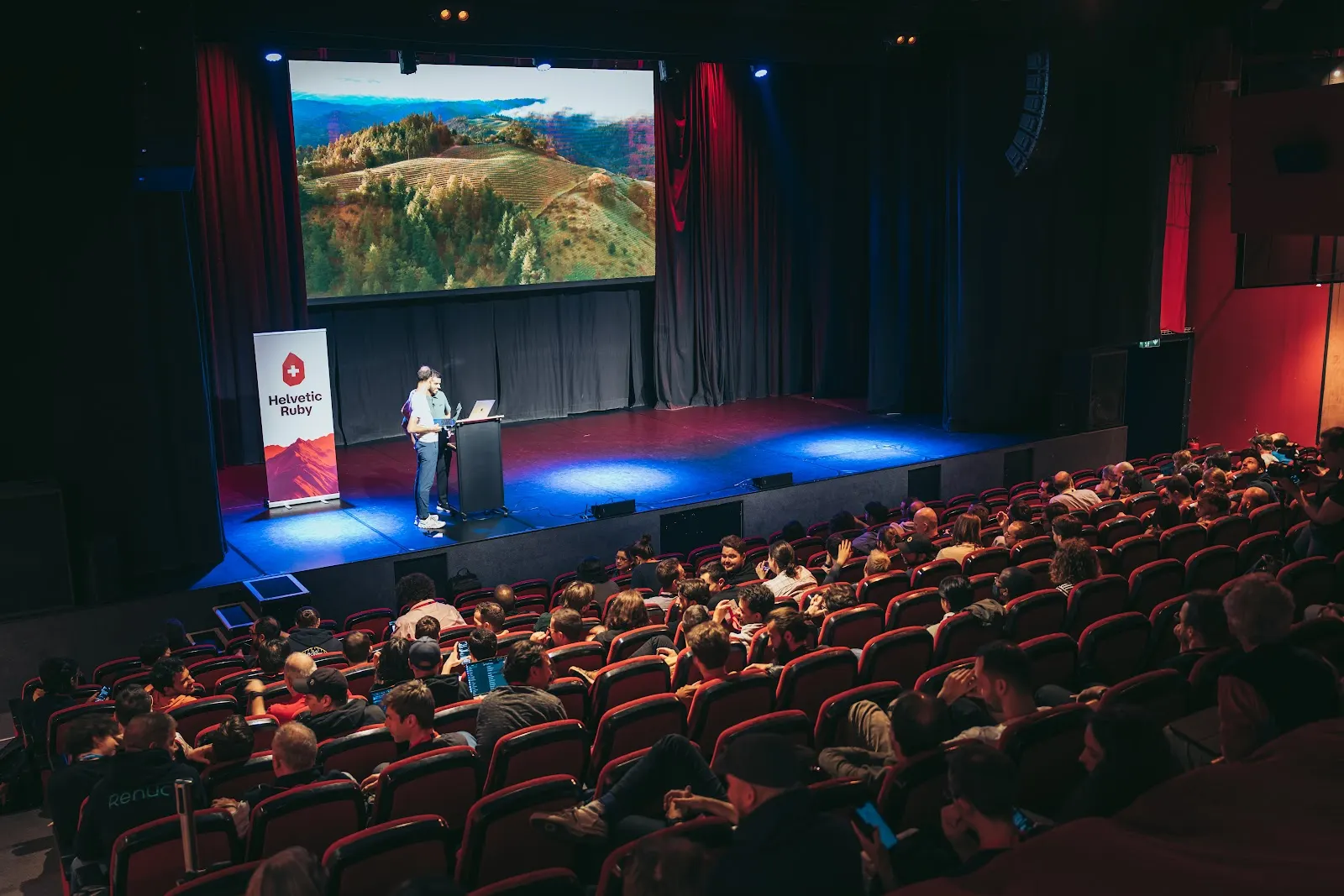
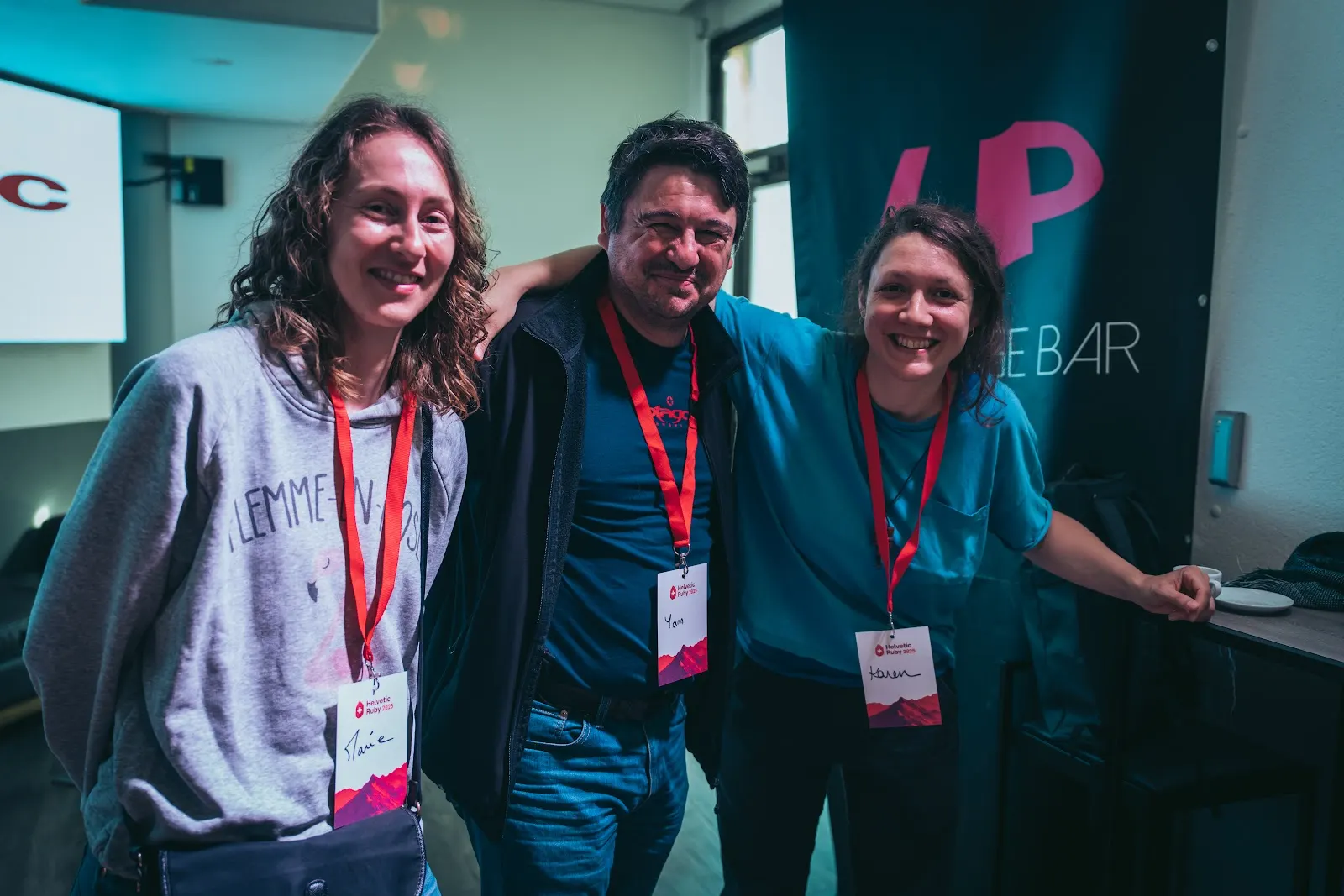
Helvetic Ruby 2026: 19 and 20 November in Zurich
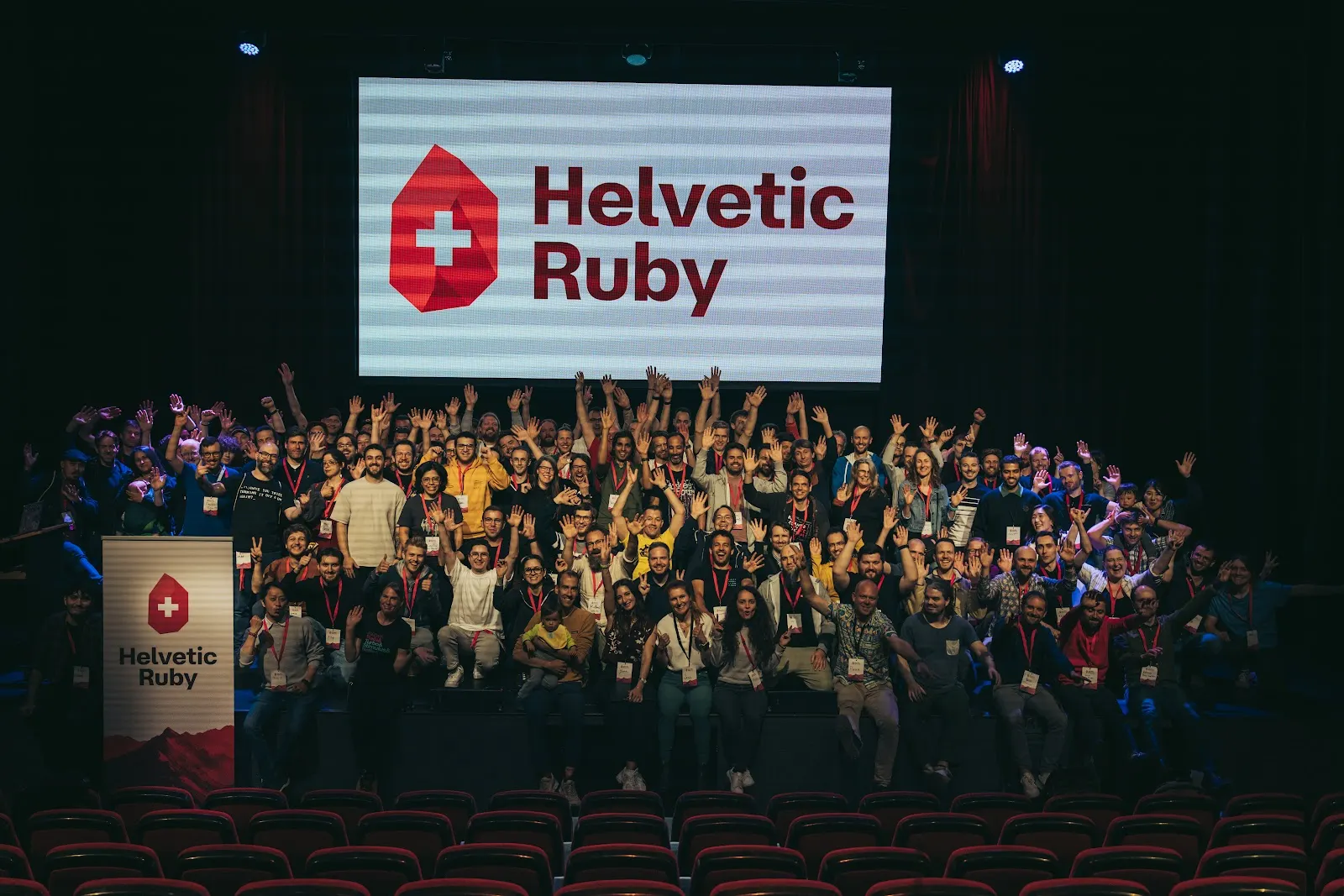
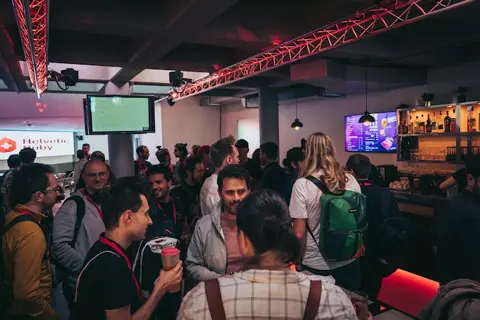
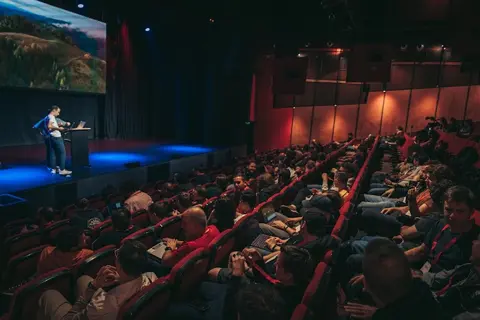
Helvetic Ruby is the Swiss Ruby conference: single track, with long breaks to talk to people. After Bern (2023), Zurich (2024) and Geneva (2025), it returns to Zurich in 2026, at the Technopark, Technoparkstrasse 1.
 Dimiter Petrov
 Hana Harencarova
- Thursday, 19 November: community day
- Friday, 20 November: talks
- Saturday: more community activities
Talks in 2026 include:
- Iliana Hadzhiatanasova: From Rails 3.0 to Rails Edge, 15 years of Rails upgrades in a 3 million line monolith
- Benoit Daloze (TruffleRuby): Running Native Extensions and Ruby Code in Parallel Threads
- Xavier Noria (Rails Core, Zeitwerk): It Works, but There’s Something Off
- Jade Dickinson: Building a multi-user reservation system across Hotwire and a Rails API
- Esti Álvarez Otero: The database diet that slimmed down our codebase too
- Daniel Colson: Regex as Easy as /(abc)?/
- KJ Loving: Mirrors Don’t Have Opinions






Swiss sponsors include QoQa, Renuo, Puzzle ITC, pia Planer, Deplo.io and SwissDevJobs. In 2025, Endress+Hauser from Reinach (Basel-Landschaft), which uses Ruby itself, and RoRvsWild, a monitoring tool for Rails apps made by Base Secrète in Geneva, were sponsors too. Tickets · Helvetic Ruby on RubyEvents with videos from previous years.
Talks from previous years on video
All Helvetic Ruby talks are free to watch on RubyEvents.org. A selection:
2025, Geneva · all talks
 Contributing to Ruby Core: From Local Development to Global ImpactJasveen Sandral
 The Test Pyramid and the Temple of LoveRonan Limon Duparcmeur
 ActiveRecord Unveiled: Mastering Rails’ ORMJess Sullivan
 More feedback! Quantity becomes qualityKyle d'Oliveira
 Beyond Caching: Best Practices for Scaling your Rails ApplicationKinsey Durham Grace
 Modelling the Cosmos in Ruby: Applying OOP and DDD to Astronomical ConceptsRémy Hannequin
 The art of code: Finding Aesthetics in logic.Yara Debian
2024, Zurich · all talks
 Revisiting the Hotwire Landscape after Turbo 8Marco Roth
 The Boring Bits Bite BackKatie Miller
 Lessons learned from running Rails apps on-premiseAndy Pfister
 Ask your logsYoussef Boulkaid
 The Very Hungry TransactionDaniel Colson
 How to Accessibility if You’re Mostly Back-EndHilary Stohs-Krause
 The Power of Crystal: A language for humans and computersJohannes Müller
2023, Bern · all talks
 Profiling Ruby tests with Swiss precisionVladimir Dementyev
 A Sneak Peek into Ractors!Abiodun Olowode
 How to Keep your Database HappyKaren Jex
 Postcards From An Early-Career Developer's First MonthsHarriet Oughton
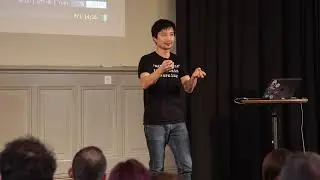 The Functional AlternativeJu Liu
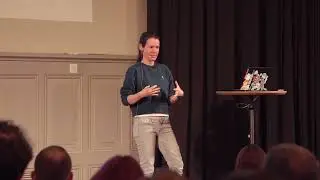 How to bootstrap your software startupIsabel Steiner
 A Rails performance guidebook: from 0 to 1B requests/dayCristian Planas and Anatoly Mikhaylov
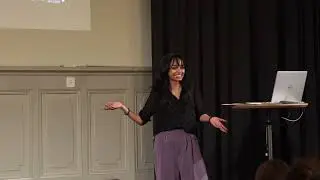 Anatomy of a Sonic Pi SongRaia
More meetups
- Ruby on Rails Switzerland Meetup: regular meetups of Rails developers in Zurich.
- Geneva.rb Meetup: meetups in Geneva, next one on 2 December 2026.
- Tech Kafi #ruby at Puzzle ITC: public talks by Puzzle in Bern (in German), one hour in the morning. In November 2025, Pascal Zumkehr reported from Rails World in Amsterdam on Rails 8.1 and Hotwire. Upcoming dates are on Puzzle Events.
- Ruby Monstas Zurich: free programming courses for beginners.
- All Ruby events and Rubyists in Switzerland on RubyEvents.org
Events outside Switzerland
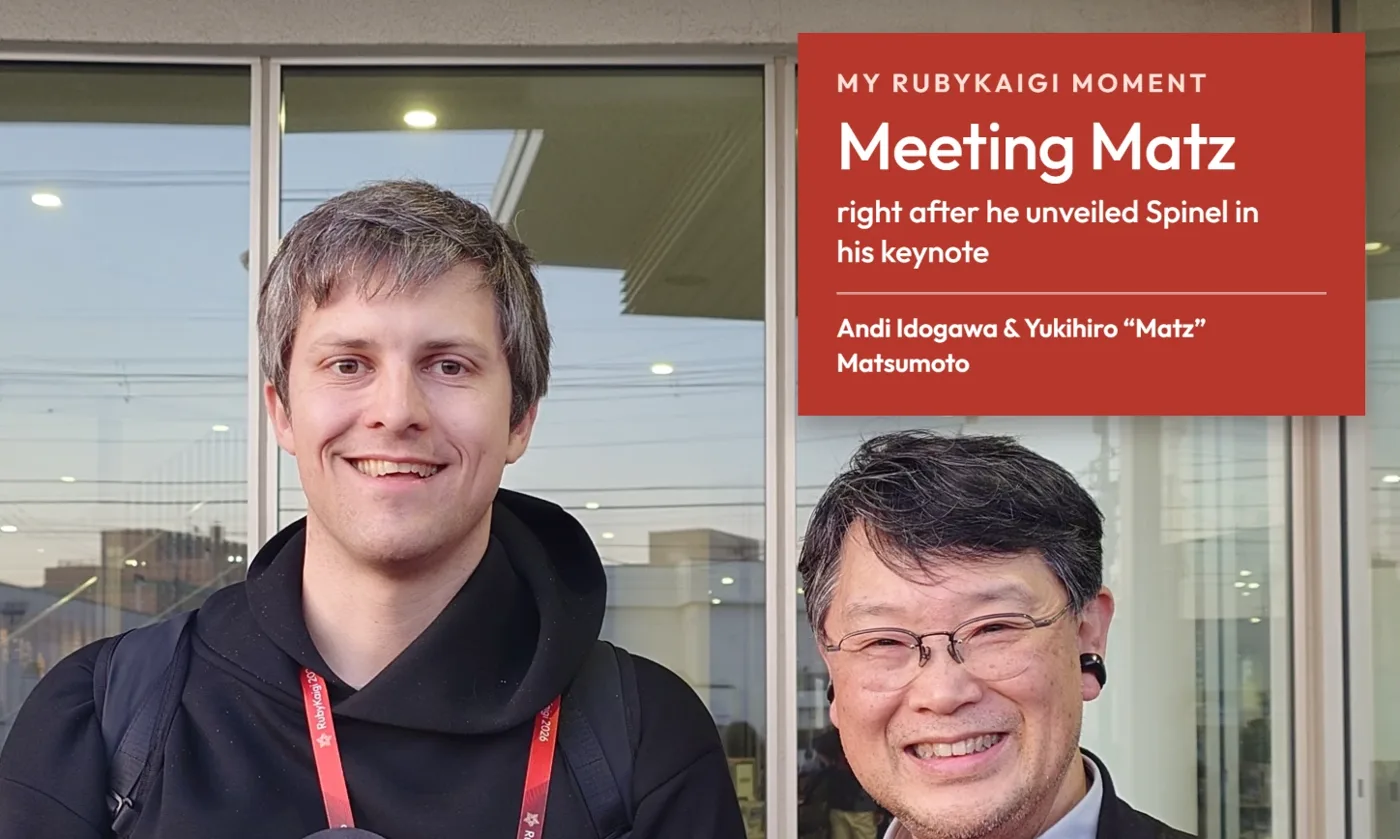
- RubyKaigi: the international gathering of Ruby core developers and everyone interested, in Japan. Japanese attendees are always happy to meet international visitors, and there is lively exchange after the talks at parties and events like karaoke.
- EuRuKo: the largest Ruby conference in Europe, in a different city every year.
- RubyWorld: Japanese Ruby business conference with an international touch.
- RubyConf: annual Ruby conference in the USA.
- Rails World: annual two-day international Ruby on Rails conference.
- Baltic Ruby around the Baltic Sea: 2024 in Malmö, Sweden, 2025 in Riga, Latvia.
- RubyConf Austria in Austria, Rubycon in Italy.
Conference talks on video
Talks from many Ruby conferences and meetups can be watched for free on RubyEvents.org:
Links
Author: Andi Idogawa, Ruby developer in the Aarau region, Aargau, Switzerland.